What Is a Scam Awareness Tool and How It Protects You
Most people think staying safe online is just about being careful. But “being careful” is vague advice that scammers have already anticipated. A scam awareness tool changes that equation. Rather than relying on gut instinct alone, these tools combine real-time detection, behavioral cues, and scam awareness resources to give you something concrete to act on. This article explains exactly what these tools are, how they work, and how you can use them to protect your money and personal information every day.
Table of Contents
- Key takeaways
- What is a scam awareness tool, really?
- Red flags that scam tools are designed to catch
- How different scam tool types compare
- How to use scam tools effectively every day
- My honest take on scam awareness tools
- Check any suspicious link with Scamkit for free
- FAQ
Key takeaways
| Point | Details |
|---|---|
| Tools go beyond advice | Scam awareness tools actively detect threats using AI, databases, and behavioral pattern matching. |
| Red flags are predictable | Urgency, unexpected contact, and gift card payment demands are consistent signals every tool targets. |
| No tool catches everything | Most tools excel at first-contact detection but need your judgment for follow-up recovery scams. |
| Use tools inside a workflow | Stop, capture evidence, check with a tool, then decide. This sequence beats reactive responses every time. |
| Education multiplies protection | Pairing detection tools with learning programs builds the kind of scam resilience that holds up long-term. |
What is a scam awareness tool, really?
A lot of people think scam awareness means reading articles about fraud or following a tip sheet from their bank. Those are useful, but they are not tools. A scam awareness tool is a consumer-facing digital service that detects, warns about, or educates users on suspicious calls, emails, links, and messages, often in real time.
The category is broader than most people realize. It includes:
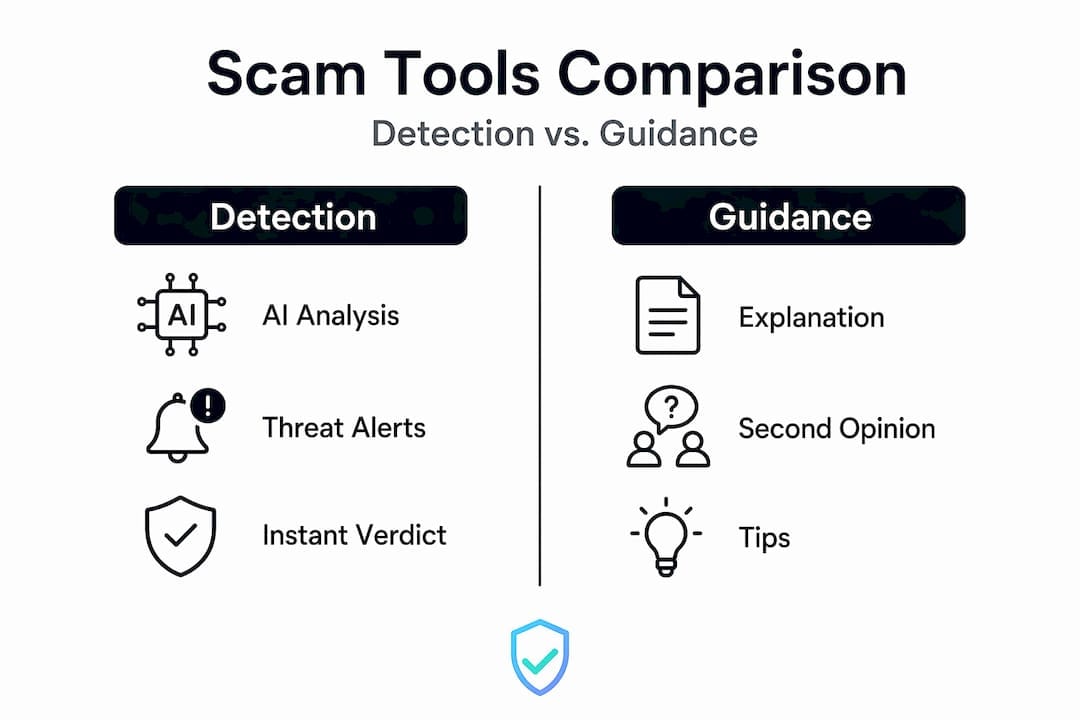
- AI-based message analyzers that scan incoming texts for language patterns associated with phishing or social engineering
- URL and link scanners that cross-reference suspicious web addresses against threat databases
- Phone number lookup tools that flag numbers reported for fraud or robocalling
- Email header inspectors that reveal spoofed senders hidden behind legitimate-looking addresses
- Interactive educational programs that teach users to spot scam patterns through scenario-based learning
The technology powering these tools varies. Some use AI analyzing call patterns to flag suspicious behavior before you even answer. Others pull from live threat databases maintained by cybersecurity organizations. URL scanners, for example, check links against blocklists from sources like Google Safe Browsing and AbuseIPDB. The result is a risk assessment you can read in plain English, not a wall of technical data.
What ties all of these together is their purpose: to give you a second opinion before you act. Scams are deceptive schemes targeting money, personal information, or account access, most often delivered through email, fake websites, or social media. A scam awareness tool intercepts that moment of uncertainty and gives you something more reliable than instinct.
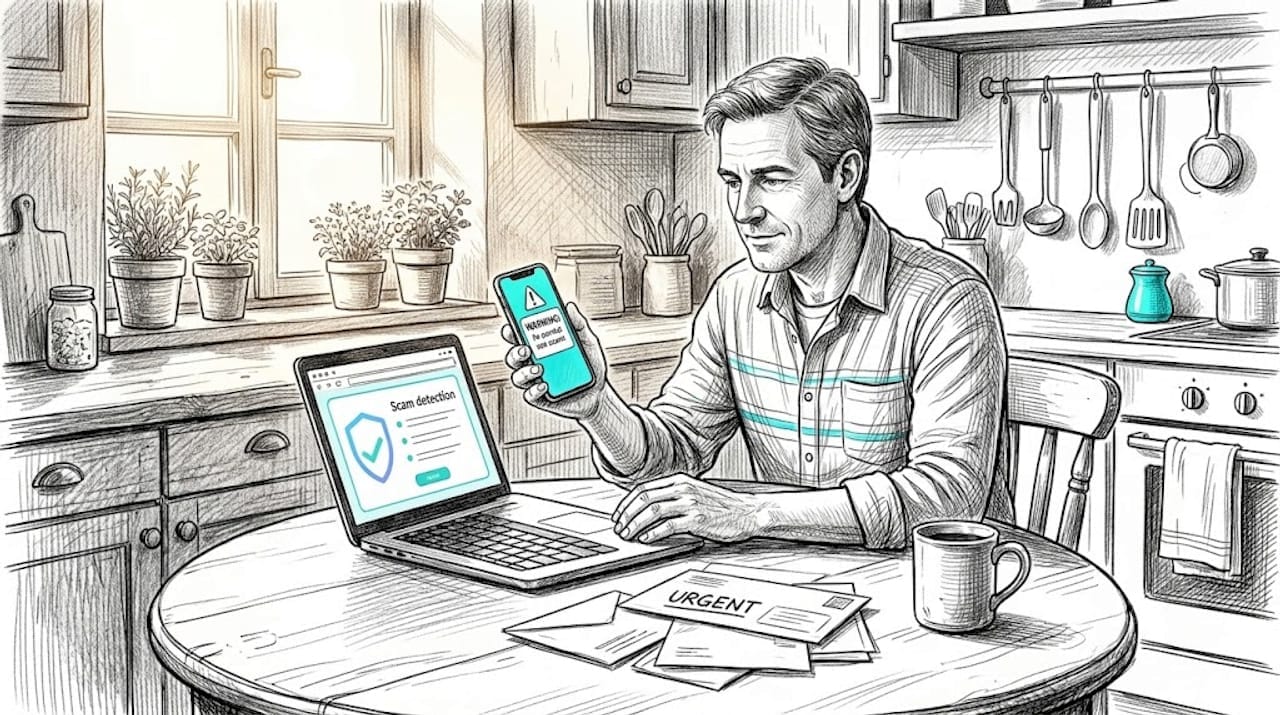
Pro Tip: Not all scam awareness tools require a login or subscription. Free tools like Scamkit let you paste a suspicious link, message, or phone number and get a risk verdict in seconds, with no account needed.
Red flags that scam tools are designed to catch
Scammers are consistent. That might seem like a strange thing to say, but it is actually good news for you. The tactics that work on victims tend to cluster around the same behavioral patterns, and that makes them detectable.
The FTC warns that the most reliable red flags include:
- Unexpected contact. A message or call you did not initiate, especially one claiming urgency or authority, is a primary signal. Scammers often pose as banks, government agencies, or tech support.
- High-pressure tactics. “Act now or your account will be closed.” Pressure to decide before you can think is intentional. It short-circuits your judgment.
- Unusual payment demands. Requests for gift cards, wire transfers, or cryptocurrency are almost never legitimate from real organizations. These payment methods are hard to trace and nearly impossible to reverse.
- Requests for personal information. Any unexpected ask for your Social Security number, bank credentials, or passwords is a serious warning sign.
- Too-good-to-be-true offers. A prize you did not enter, a job paying unrealistic wages, or a refund you were not expecting.
Scam awareness tools are built around these exact patterns. When you paste a suspicious message into an analyzer, it looks for this language. When you scan a URL, the tool checks whether the domain was recently registered or has been flagged in fraud reports. The technology mirrors what a trained fraud investigator would look for, but delivers it to you instantly.
“Scammers rely on pressure and urgency to short-circuit your thinking. Slowing down is one of the most powerful things you can do.”. FTC Consumer Advice
This is why the best scam prevention tools do not just return a verdict. They explain why something looks suspicious, so you build pattern recognition over time.
How different scam tool types compare
Understanding what each type of tool does well, and where it falls short, helps you pick the right one for the right situation. Here is a practical breakdown:
| Tool type | Best for | Limitation |
|---|---|---|
| AI message analyzers | Detecting phishing language in texts and emails | May miss highly personalized spear-phishing messages |
| URL and link scanners | Identifying malicious or newly registered domains | Cannot always detect scam sites that just launched |
| Phone number lookup tools | Flagging reported fraud numbers before you call back | Relies on community reports, so new numbers may not be flagged |
| Email header inspectors | Exposing spoofed sender addresses | Requires some technical familiarity to interpret raw headers |
| Educational programs | Building long-term recognition of evolving scam tactics | Passive learning only, no real-time detection |
| Platform safety warnings | Catching scams on social media or within apps | Limited to the platform’s own data and scope |
One distinction worth understanding is first-contact versus follow-up protection. Most scam detection tools are strongest at the moment you first receive a suspicious message or link. They are genuinely good at catching scams on first contact. Where they get weaker is in “recovery scams,” where a fraudster contacts someone who already lost money and promises to help them recover it, for a fee. These scams exploit emotional vulnerability and often arrive through channels that look legitimate.
For those situations, your own skepticism and independent verification matter just as much as any tool. A good rule: if someone contacts you unsolicited about getting your money back, treat it like any other unexpected contact and verify through official channels.
Pro Tip: Android devices running version 11 and above are rolling out anti-spoofing features starting in 2026 that automatically end calls from spoofed bank numbers. Check your phone settings to confirm these protections are active.
Tools work best when they are part of your decision workflow, not a replacement for it. Think of them as a second opinion, not a final verdict.
How to use scam tools effectively every day
Knowing a tool exists is not the same as knowing how to use it well. Here is how to build scam awareness tools into a practical daily habit.
Start with a pause. The single most powerful thing you can do when something feels off is stop. Do not click, call back, or respond. This alone removes the urgency that scammers depend on. The FTC consistently recommends controlling the interaction by slowing it down.
Once you have paused, build this workflow:
- Capture the evidence. Screenshot the message, copy the URL, or note the phone number. You will need this for the tool and potentially for reporting.
- Check it with a tool. Paste the URL, message text, or phone number into a scam detection tool. Look at the risk level and read the explanation, not just the verdict.
- Verify through official sources. If the message claims to be from your bank, call the number on the back of your card. Do not use contact details from the suspicious message itself.
- Report it. Reporting scams to the FTC quickly can prevent further loss and helps protect others. Most tools also have community reporting features that improve detection for everyone.
- Block and move on. Once confirmed as a scam, block the number or address and delete the message.
One caution that often gets overlooked: when you use an AI-based tool, share only non-sensitive information like the message text or a URL. Never paste your account numbers, passwords, or full name into any third-party tool. The goal is to verify a threat indicator, not expose your credentials while doing it.
Scam resilience also grows over time. Combining automated detection with educational programs helps users recognize evolving tactics in ways that one-time warnings cannot. Tools like Google’s Be Scam Ready use game-like scenarios to train pattern recognition, which transfers to real-world situations your tool might not flag. For a deeper look at the full range of online scam types you might encounter, understanding the full scope makes you a harder target across the board.
My honest take on scam awareness tools
I have spent years watching how people respond to fraud attempts, and the pattern I see most often is not ignorance. It is overconfidence in one thing and nothing else. Someone installs a link scanner and assumes they are covered. Or they read a few articles about phishing and figure awareness is enough. Neither approach holds up when a scammer gets personal.
What I have learned is that the combination matters more than any single layer. Technology handles speed and scale. It catches things you would miss at 11pm when you are tired and a message from “your bank” arrives. But education handles the edge cases, the personalized emails, the text from someone pretending to be a family member in trouble, the follow-up call after you almost fell for something once. Those require pattern recognition that only comes from actually learning the tactics.
I also think people underestimate how fast scams evolve. A tool trained on last year’s phishing patterns has blind spots for this year’s deepfake voice calls or AI-generated message threads. That is not a reason to distrust tools. It is a reason to stay curious and keep updating your mental model of what scams look like right now.
My real advice: treat scam tools as decision aids. They are genuinely useful for buying you a few seconds of clarity when pressure is high. But the goal is to build your own judgment alongside them, not instead of them. A tool that makes you pause and think is worth more than a tool you blindly trust.
. Isaiah
Check any suspicious link with Scamkit for free
If you have ever stared at a strange text or questionable email and wished you had a fast, reliable way to check it, that is exactly what Scamkit is built for. Scamkit is a free multi-source scam checker that pulls data from trusted security databases including Google Safe Browsing, AlienVault OTX, and AbuseIPDB to give you a plain-English risk verdict in seconds.
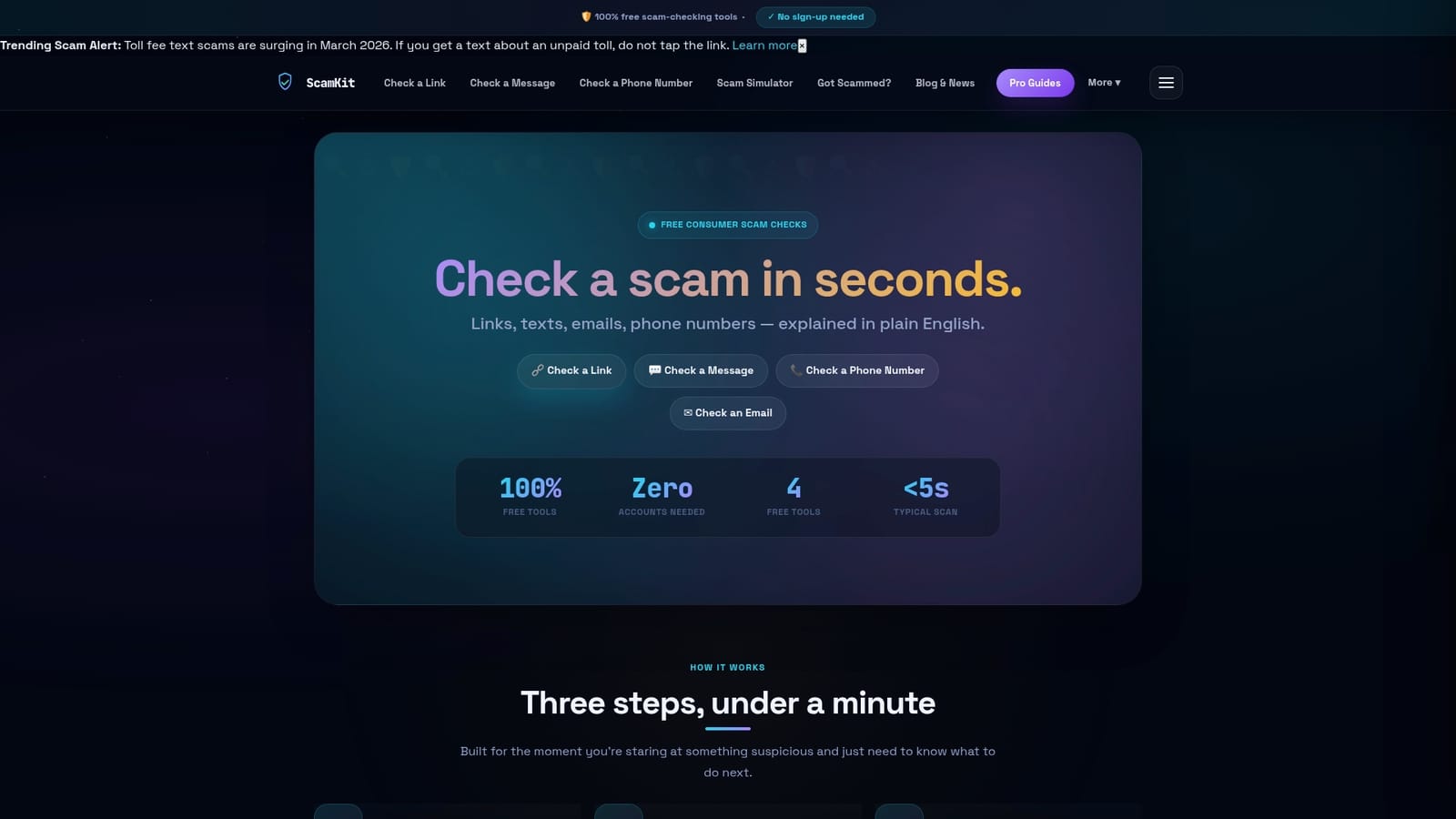
No sign-up. No technical knowledge required. You paste a suspicious URL, message, phone number, or email header into the right tool, and Scamkit tells you what it found and what to do next. It covers the full range of common scams, from phishing links to fake job offers to crypto fraud. For a step-by-step walkthrough of staying safe online, the scam spotting guide on the Scamkit blog is a practical companion to the tool itself. Whether you are protecting yourself, a parent, or your small business, Scamkit gives you a real second opinion when it matters most.
FAQ
What is a scam awareness tool used for?
A scam awareness tool helps you detect and evaluate suspicious messages, links, phone numbers, and emails before you respond. It combines real-time threat data with plain-language guidance so you can make safer decisions quickly.
Are scam prevention tools free to use?
Many scam prevention tools are free. Scamkit, for example, requires no sign-up and delivers results in seconds by cross-referencing threat databases from sources like Google Safe Browsing and AbuseIPDB.
What are the biggest red flags a scam alert system looks for?
The most consistent red flags include unexpected contact, pressure to act immediately, and requests for payment via gift cards, wire transfers, or cryptocurrency. The FTC identifies these as the most reliable early indicators of fraud.
Can a scam awareness tool catch every scam?
No tool catches everything. Most scam detection tools are strongest at first contact but have limitations with highly personalized messages or recovery scams. Use tools as part of a broader workflow that includes verifying through official sources and trusting your instincts when something feels wrong.
How do I identify scams without a tool?
Look for urgency, unexpected requests for personal information or money, and any demand to use untraceable payment methods. Slowing down and independently verifying the contact through official channels removes most of the risk even without technology.