Phone Scam Types for Seniors: Stay Protected in 2026
Phone scams targeting seniors have never been more sophisticated or more financially devastating. Over 48,000 seniors filed phishing and spoofing complaints in 2025 alone, representing nearly a quarter of all senior fraud reports. Knowing the specific phone scam types for seniors is not just useful knowledge. It is your single strongest line of defense. Scammers count on confusion and surprise. This guide removes both by walking you through the most common scams targeting seniors right now, what each one sounds like, and exactly what to do when one reaches you.
Table of Contents
- Key Takeaways
- 1. Grandparent and family emergency scams
- 2. Tech support scams: fake virus alerts and remote access traps
- 3. Government impersonation scams: fake IRS, Social Security, and Medicare calls
- 4. Prize, lottery, and sweepstakes scams: the false winning call
- 5. Robocall scams: the “can you hear me?” trick
- 6. Verification code laundering: a scam hiding inside “help”
- 7. Investment and cryptocurrency fraud targeting seniors
- 8. Debt relief and credit repair phone scams
- My take on why awareness is seniors’ best defense
- How Scamkit can help you spot scams before they cause harm
- FAQ
Key Takeaways
| Point | Details |
|---|---|
| Grandparent scams use voice cloning | Scammers can now mimic a family member’s voice, so always call back on a known number to verify. |
| Government agencies never call demanding payment | The IRS, Social Security Administration, and Medicare will never ask for gift cards or wire transfers by phone. |
| Remote access requests are red flags | Giving a caller control of your computer almost always leads to stolen banking information or malware. |
| Robocalls can record and weaponize your “yes” | Saying “yes” to an automated caller can be used to authorize fraudulent charges without your knowledge. |
| Verification beats panic every time | Hanging up and calling back using an official number is the safest response to any suspicious call. |
1. Grandparent and family emergency scams
This one hits hardest because it targets love. A scammer calls claiming to be your grandchild, or a lawyer or police officer acting on their behalf, and says there has been an accident, an arrest, or a medical emergency. They need money fast. And please, do not tell anyone.

Scammers use caller ID spoofing and voice cloning to make the call look and sound genuine. Voice cloning technology can now recreate a family member’s voice using just a few seconds of audio pulled from social media. The emotional jolt of hearing what sounds like your grandchild in distress is designed to override your judgment.
Watch for these red flags:
- Pressure to act immediately, before you can think or check
- Requests for secrecy, specifically telling you not to call other family members
- Payment demanded via wire transfer, gift cards, or cash sent through a courier
- A “lawyer” or “bail bondsman” calling right after the supposed family member
What to do: Hang up. Call your grandchild or family member directly using a number you already have saved. Do not call back the number that just contacted you. Verify independently through trusted numbers before you do anything else.
Pro Tip: Agree on a secret code word with your grandchildren now. If someone calls claiming to be them and cannot give the code word, you know it is a scam.
2. Tech support scams: fake virus alerts and remote access traps
You are browsing the internet when a loud alarm sounds from your computer and a pop-up fills the screen. It says your device is infected and you must call a number immediately. Or the phone rings and someone from “Microsoft” or “Apple” warns you that your account has been compromised.
Tech support scams follow a predictable sequence: a fake alert or unsolicited call creates panic, then the caller asks for remote access to your device to “fix” the problem. Once they are in, they can see your banking details, install malware, or lock you out entirely. Then comes the fee, requested via wire transfer, gift cards, or cryptocurrency because those methods are nearly impossible to trace or reverse.
Seniors lose tens of thousands on tech support scams every year because the scenario feels genuinely alarming. A blaring alert on your screen looks real. A confident, professional-sounding caller sounds trustworthy.
- Never call a number shown on a pop-up alert
- Never allow remote access to someone who contacted you first
- Real tech companies do not make unsolicited calls about device problems
- Close the browser tab or restart your computer if you see a scary pop-up
Pro Tip: If a pop-up freezes your screen, press and hold the power button to shut the computer down completely. The “virus” almost always disappears with a restart.
You can learn more about how these alerts work at Scamkit’s guide to tech support pop-up scams.
3. Government impersonation scams: fake IRS, Social Security, and Medicare calls
These calls are built on fear. Someone calls claiming to be from the IRS, the Social Security Administration, or Medicare. They say your benefits are being suspended, you owe back taxes, or a warrant has been issued for your arrest. Pay now or face consequences.
Government imposter scams rose 40% in 2025, with losses topping $3.5 billion. The callers use spoofed numbers that look like real government agency lines. They are skilled at sounding authoritative.
Here is what you need to know about how real government agencies actually operate:
| Agency | How they actually contact you | What they will never do |
|---|---|---|
| IRS | Mailed letters first | Demand immediate payment by phone or gift card |
| Social Security Administration | Written notices | Threaten arrest over the phone |
| Medicare | Mail and your doctor’s office | Ask for your Medicare number over an unsolicited call |
Treat any official-sounding call as high risk until you verify it independently. Hang up and call the agency directly using the number on their official website or on your account documents. Never call back the number that called you.
For a deeper look at how these scams work and how to spot them before they go further, Scamkit has a full breakdown on stopping impersonation scams.
4. Prize, lottery, and sweepstakes scams: the false winning call
You get a call telling you that you have won a prize, a lottery, or a sweepstakes you may not even remember entering. It sounds exciting. The caller says all you need to do to claim your winnings is pay a small fee for taxes, processing, or shipping.
There are no winnings. The fee is the scam.
These calls are among the most effective types of fraud for older adults because they trigger genuine excitement before the critical thinking kicks in. Scammers know this and they work fast, pushing you to pay before the excitement fades.
Common warning signs to watch for:
- You are told you won a contest you never entered
- You must pay something first to receive your prize
- Payment is requested via gift cards, wire transfer, or a money order
- The caller urges you to keep the winning secret until after you pay
The rule is simple. Legitimate sweepstakes do not require you to pay anything upfront. If there is a fee to claim a prize, it is a scam. Hang up.
5. Robocall scams: the “can you hear me?” trick
You answer the phone and an automated voice asks, “Can you hear me?” This is not a harmless question. Scammers record your “yes” response to use as fake voice authorization for charges you never agreed to. When you dispute the charge, they play back your recorded “yes” as proof of consent.
Robocalls also deliver threatening messages about lawsuits, expired warranties, or account problems. The goal is to get you to press a button or call back a number, both of which connect you to a live scammer.
What helps most is a habit change. Do not answer calls from numbers you do not recognize. If the call is genuine, the caller will leave a voicemail. Never say “yes” to a question from an automated caller you did not initiate. And never press any button the automated message instructs you to press, even if it claims to remove you from a call list.
6. Verification code laundering: a scam hiding inside “help”
This one is less well-known but growing fast. A caller says they are from your bank, your email provider, or even a government agency. They say they detected suspicious activity on your account and they need to verify your identity. A code will be sent to your phone. Could you please read it back to them?
That code is a one-time password being used to reset your account. By reading it aloud, you hand the scammer full access to your account. Any request to share a verification code should be treated as a near-certain sign of fraud, regardless of how helpful the caller sounds.
Real banks and companies send verification codes so that you can log in. They do not call you and ask you to read the code back to them. That is not how account protection works. Hang up and contact your bank directly.
7. Investment and cryptocurrency fraud targeting seniors
Investment scams are among the most financially destructive phone scam types for seniors. The call often comes from someone who has built trust over days or weeks, positioning themselves as a financial advisor or a friend with a hot tip. The pitch eventually moves toward an investment opportunity with impressive guaranteed returns.
Investment schemes caused over $3.5 billion in losses to seniors, with cryptocurrency-involved scams causing more than $4.3 billion in losses across 42,000 victims. Cryptocurrency is especially favored by scammers because transfers are nearly instant and almost impossible to reverse.
If a caller you did not seek out is offering you a financial opportunity, the answer is always the same. Tell them you will look into it independently and hang up. A genuine investment opportunity does not require a decision during a phone call. You can also look into common scam tactics before considering any unsolicited offer.
8. Debt relief and credit repair phone scams
Scammers know that financial stress makes people more vulnerable. So they call seniors with promises to erase debt, negotiate with creditors, or repair credit scores, for an upfront fee paid before any work begins.
These services either do nothing or disappear entirely after collecting payment. Real nonprofit credit counseling services exist and are often free. Any organization demanding payment before providing debt relief is almost certainly a scam.
Red flags include promises that sound too absolute (“we can eliminate all your debt”), pressure to pay immediately, and requests for your Social Security number or bank account details over the phone before any formal agreement is in place.
My take on why awareness is seniors’ best defense
I have spent years reading fraud reports and speaking with people who were targeted by phone scams. And the one thing that consistently stands out is this: the seniors who avoid getting hurt are not the ones who are more tech-savvy. They are the ones who know what to expect.
Scammers succeed through surprise and speed. They want you reacting emotionally before you have a chance to think. The best defense is simply not to engage. Hang up. That single habit disrupts more scam attempts than any technology or filter ever could.
In my experience, the people who get hurt often say afterward, “Something felt off but I did not want to be rude.” You are not being rude by hanging up on a scammer. You are protecting yourself. Trust that instinct. If a call feels wrong, it almost certainly is.
There are real resources that can help if you receive a suspicious call. The FTC at reportfraud.ftc.gov and your local Area Agency on Aging are good places to start. Reporting matters because it helps protect others.
. Isaiah
How Scamkit can help you spot scams before they cause harm
Knowing the phone scam types for seniors is a powerful start. Having a tool to quickly check suspicious numbers, links, or messages makes your protection even stronger.
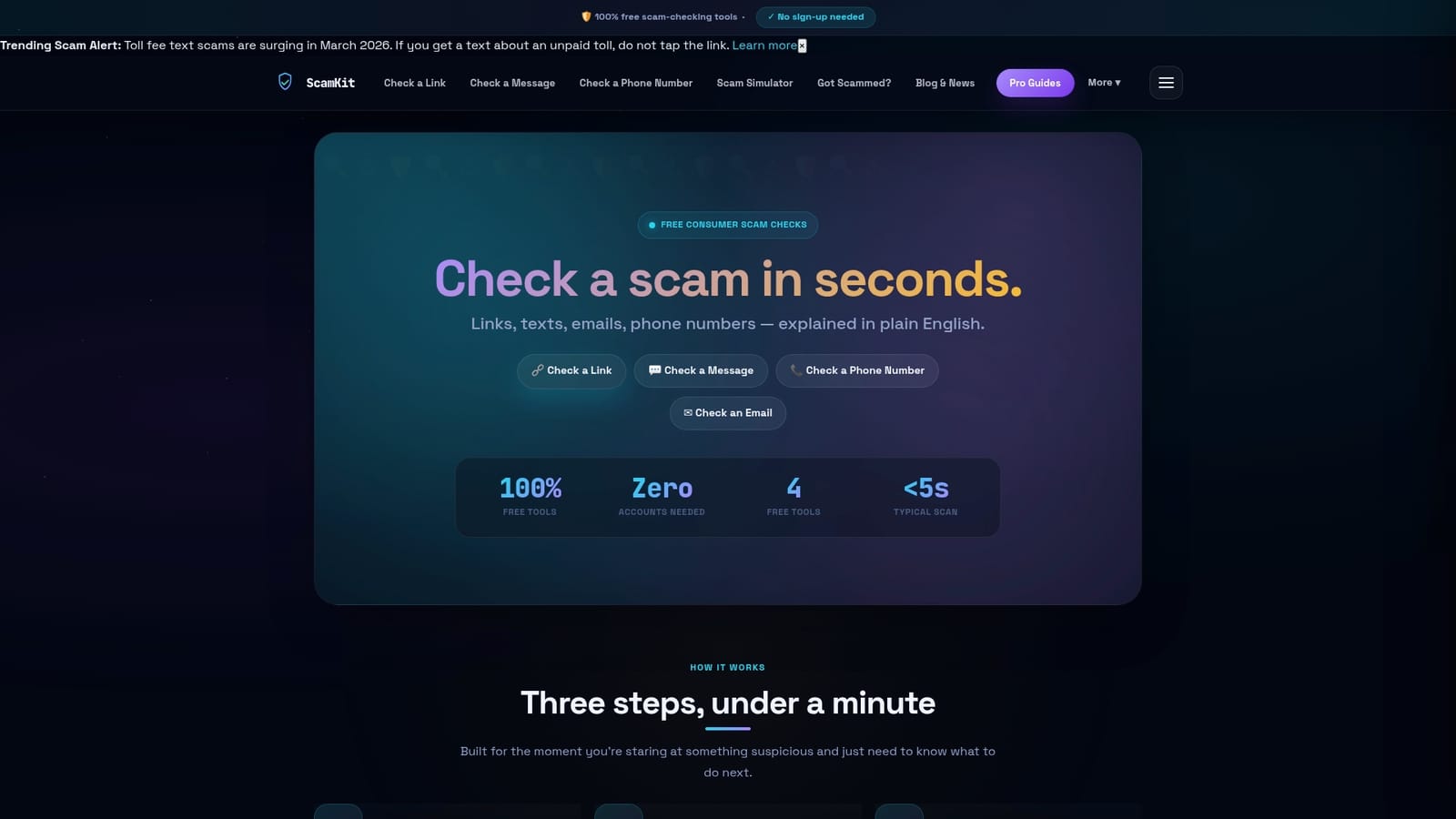
Scamkit is a free online tool built for exactly this situation. If you receive a suspicious call, you can check the phone number directly using Scamkit’s free phone checker to see if it has been reported as a scam source. Got a suspicious text with a link? Paste it into Scamkit’s multi-source scam checker and get a plain-English verdict in seconds, pulling data from trusted security sources like Google Safe Browsing and AbuseIPDB. No account required and no cost. Scamkit also explains common scam types so you can recognize them the next time a suspicious call comes in.
FAQ
What are the most common phone scam types for seniors?
The most common types include grandparent scams, tech support scams, government impersonation calls, prize and lottery scams, robocalls, and investment fraud. Each uses urgency and emotional pressure to push seniors into acting before they can verify the caller.
How can I tell if a government call is fake?
Real government agencies like the IRS and Social Security Administration contact you by mail first and never demand immediate payment by phone. If a caller threatens arrest or benefit suspension and asks for a gift card or wire transfer, it is a scam.
What should I do if I answered a suspicious call?
Hang up as soon as something feels wrong. Do not provide any personal information, verification codes, or payment. Call the organization directly using a number from their official website to check whether the contact was real.
Can scammers clone a family member’s voice?
Yes. Voice cloning technology can replicate someone’s voice from just a few seconds of audio found online. If you receive an emergency call from a family member, hang up and call them back using a number you have saved yourself.
Is it safe to say “yes” on an automated call?
Avoid saying “yes” to any question from an automated caller you did not initiate. Scammers record that response and use it to falsely authorize charges on your accounts.