How to report a scam: step-by-step guidance for safety

TL;DR:
- Report scams promptly to multiple agencies and document all evidence for effective action.
- Secure accounts by changing passwords, enabling 2FA, and monitoring for unusual activity.
- Reporting helps law enforcement identify patterns, but individual recovery is unlikely; collective action is key.
Scams hit hard. The financial loss stings, but the feeling of helplessness can be even worse. You might be sitting there wondering what you should do next, who to call, or whether it even matters. It does matter. In 2024, 859,532 scam complaints were filed with the FBI’s Internet Crime Complaint Center, with losses topping $16 billion. That’s not a small problem. And if you’ve been targeted, you’re not alone and you’re not out of options. This guide walks you through every step: what to do right away, who to contact, how to protect your accounts, and how to avoid common mistakes that slow things down.
Table of Contents
- What to do first when you spot a scam
- Who to contact: Reporting scams to agencies and institutions
- Protecting your accounts and personal information
- Common reporting mistakes and special cases
- The hard truth about scam reporting and what actually works
- Tools and proactive protection to help you stay safe
- Frequently asked questions
Key Takeaways
| Point | Details |
|---|---|
| Act quickly | The sooner you report a scam, the better your chance of minimizing loss and helping investigations. |
| Document thoroughly | Save all evidence of the scam, including messages, receipts, and any transaction details. |
| Report to the right place | Use official agencies like the FTC, FBI IC3, and your state’s consumer protection office for best results. |
| Secure your accounts | Contact your bank and update credentials to prevent further damage after a scam. |
| Prevention matters | Learning from each incident and using prevention tools reduces risk of future scams. |
What to do first when you spot a scam
Once you realize something is wrong, stop everything. Do not reply to the scammer, do not click any more links, and do not send any more money. The very first move is to protect yourself from further harm, and that starts with cutting off contact.
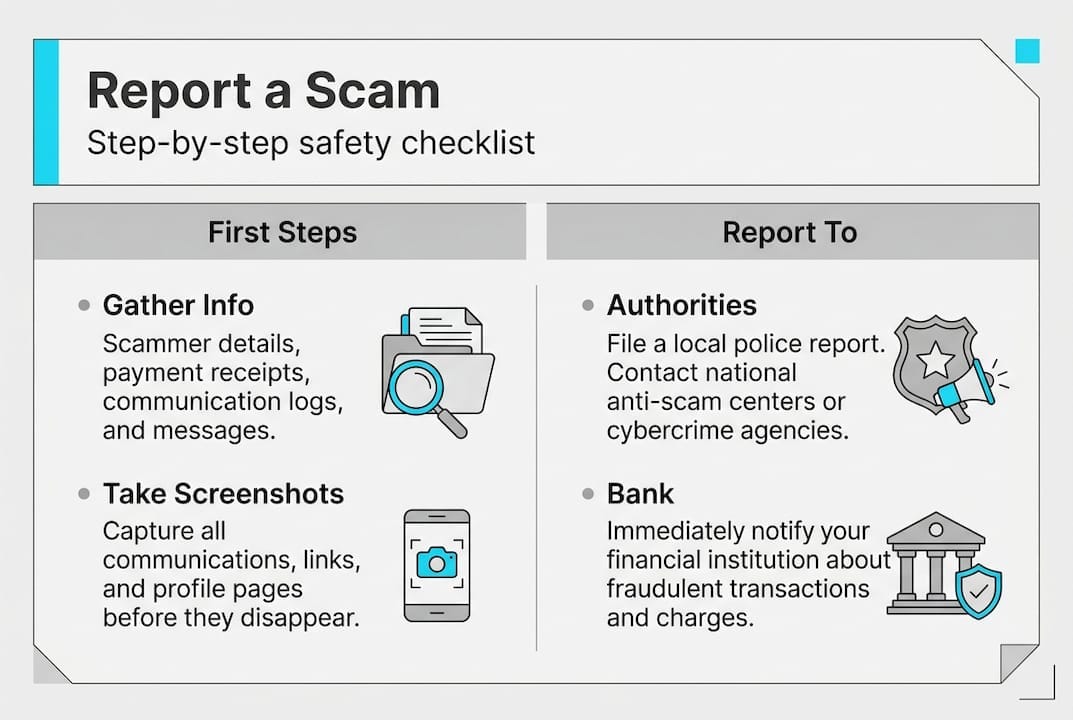
Then, document everything you can. Think of this as building your case file. The more detail you capture right now, the stronger your report will be later.
Here’s what to gather:
- Screenshots of all messages, emails, or social media conversations with the scammer
- The scammer’s contact information: phone number, email address, username, or website URL
- Any receipts, transaction records, or bank statements showing money sent or accounts accessed
- Dates and times of every interaction you remember
- Notes on what was said, including any promises made or threats used
Don’t delete anything, even if it feels uncomfortable to look at. Evidence like screenshots and receipts is exactly what agencies need to build a solid report and potentially act on your case.
If you paid by wire transfer, gift card, or cryptocurrency, write down the exact amounts, dates, and any transaction IDs. These details matter more than you might think.
Remember: You are not in trouble for being scammed. Scammers are skilled manipulators. Reporting is the right thing to do, and it helps protect others too.
Once you have your evidence organized, check out the next steps if scammed page for a clear action plan. If you’re already thinking about recovery, the guide on how to recover after a scam breaks it down step by step.
Pro Tip: Use your phone’s built-in screenshot tool to capture full conversation threads. Then email them to yourself so you have a backup copy stored safely.
Who to contact: Reporting scams to agencies and institutions
With your evidence ready, the next step is telling the right authorities. This part trips a lot of people up because there are several agencies, and it’s not always obvious which one handles what. The short answer: report to as many as apply to your situation.
Here’s a quick breakdown of who does what:
| Agency | What they handle | Where to report |
|---|---|---|
| Federal Trade Commission (FTC) | General fraud, scams, identity theft | ReportFraud.ftc.gov |
| FBI Internet Crime Complaint Center (IC3) | Online and internet-based fraud | ic3.gov |
| State Attorney General | Local business fraud, consumer disputes | Your state’s AG website |
| Your bank or financial institution | Unauthorized transactions, wire fraud | Call the number on your card |
Here’s the order we recommend:
- File with the FTC first. Your report at ReportFraud.ftc.gov gets shared with more than 2,800 law enforcement partners across the country. It’s one of the most powerful first steps you can take.
- File with the FBI’s IC3. If the scam happened online, IC3 tracks internet losses and uses that data to pursue large-scale fraud operations.
- Contact your State Attorney General. For scams involving local businesses or consumer issues, your state AG’s consumer protection division can investigate and sometimes take direct action.
- Call your bank. Do this as soon as possible. More on that in the next section.
Don’t worry if your situation overlaps multiple agencies. Report to all of them. Each report adds to a larger picture that investigators use to identify patterns and pursue cases.
Pro Tip: Keep a record of every report you file, including confirmation numbers, dates, and the agency name. This helps if you need to follow up or provide documentation later.
For more guidance on filing effectively, the best reporting strategies article covers what works and what to avoid. You can also learn more about how scammers operate by reading up on scam technique tips.
Protecting your accounts and personal information
While authorities investigate, protecting yourself and your accounts is crucial. Reporting is important, but securing what you still have is urgent.
Here’s what to do right away:
- Call your bank or financial institution immediately. If money was taken or your account was accessed, contact your bank to freeze the account, dispute charges, or attempt to reverse a transaction. Time is critical here. The sooner you call, the better your chances.
- Change your passwords. Start with your email, then your bank, then any other accounts that use the same password. Use a unique, strong password for each one.
- Turn on two-factor authentication (2FA). This adds a second layer of security so that even if someone has your password, they still can’t get in without a code sent to your phone.
- Monitor your accounts daily for the next few weeks. Look for small, unusual charges, which scammers often test before making larger withdrawals.
- Alert the credit bureaus. If personal information like your Social Security number was exposed, place a fraud alert or credit freeze with Equifax, Experian, and TransUnion.
A few more things worth doing:
- Check your email settings for any forwarding rules the scammer may have set up
- Review which apps have access to your accounts and revoke anything unfamiliar
- Scan your devices for malware if you clicked any suspicious links
Pro Tip: A credit freeze is free and stops new accounts from being opened in your name. It’s one of the strongest protective steps available and takes only a few minutes to set up with each bureau.
For a full walkthrough, the step-by-step scam recovery guide covers account protection in detail. You can also find practical digital safety steps to strengthen your overall online security.
Common reporting mistakes and special cases
Not all scams or reporting processes are the same, and many people make avoidable mistakes that weaken their case or delay action. Knowing what not to do is just as important as knowing what to do.
The most common mistakes:
- Waiting too long to report. Every day of delay makes recovery less likely and evidence harder to preserve.
- Only reporting to one agency. Different agencies have different tools and jurisdictions. File with all that apply.
- Deleting communications. Even embarrassing or upsetting messages are evidence. Keep everything.
- Not following up. If you filed a report and haven’t heard back, that’s normal. But keep your confirmation numbers in case you need to reference them.
Gift card scams need a different approach. If you were tricked into buying gift cards and sharing the codes, report to the card issuer first. Call the number on the back of the card immediately. Then file with the FTC. Acting fast here gives you the best shot at stopping the funds before they’re used.
Impersonation scams (where someone pretends to be the IRS, Social Security Administration, or a tech company) should be reported directly to the agency being impersonated, as well as the FTC. Each agency has its own fraud reporting channel.
Important: No single agency guarantees individual money recovery. But every report you file contributes to a larger dataset that drives real investigations and helps protect others.
International scams are especially frustrating. If the scammer is overseas, recovery is unlikely. But reporting still matters. Agencies use these reports to map global fraud networks and coordinate with international partners.
Learn to recognize different scam template types so you can spot them faster next time. And stay current with scam alert warnings to know what’s trending.
The hard truth about scam reporting and what actually works
Here’s something most guides won’t tell you: filing a report rarely gets your money back directly. We know that’s hard to hear. But it’s important to understand why reporting still matters enormously.
Law enforcement agencies don’t act on individual cases in isolation. They look for patterns across thousands of reports. Your single report, combined with hundreds of others about the same scammer or operation, is what triggers an investigation. That’s how major fraud rings get shut down.
The real value of reporting is collective. You might not see the outcome directly, but your action contributes to a system that protects the next person. That’s not a small thing.
What we’ve seen work best is a combination of speed and thoroughness. Report fast, report to multiple agencies, and document everything. Then focus your energy on securing your accounts and learning to recognize the tactics used against you. That knowledge is your best defense going forward.
Don’t let the uncertainty of recovery stop you from acting. Every step you take, from filing a report to tightening your account security, makes you harder to target again.
Tools and proactive protection to help you stay safe
Reporting after a scam is essential, but stopping one before it happens is even better. That’s exactly what ScamKit is built for.

With ScamKit’s free tools, you can check a suspicious scam URL checker before you click it, analyze a sketchy email using the email header analyzer, or test your scam-spotting skills with the interactive Scam Simulator. No sign-up needed. No personal information required. Just fast, clear answers when you need them most. Whether you’re protecting yourself, your family, or your small business, ScamKit gives you the tools to stay one step ahead of scammers.
Frequently asked questions
Where should I report a scam email or internet fraud?
File with the FTC at ReportFraud.ftc.gov for general scams, and use the FBI’s IC3 at ic3.gov specifically for internet and online fraud complaints.
Will I get my money back if I report a scam?
Money recovery is not guaranteed, but aggregate reports drive investigations that help law enforcement build cases and may prevent future victims from losing money.
What should I do if the scam involved a gift card?
Call the gift card issuer immediately using the number on the back of the card, then report to the FTC for the best chance of limiting your loss.
How fast should I act after discovering a scam?
Act right away. Immediate reporting and action give you the best chance of limiting financial damage and preserving evidence for investigators.
Are international scams worth reporting?
Yes. Even though international losses are rarely recovered, your report helps global agencies identify large-scale fraud networks and coordinate cross-border investigations.